 The greatest concern among pre-med students is taking the much-dreaded MCAT. Passing the MCAT and getting an outstanding, maximum score are goals that each and every pre-med student yearns to achieve. The MCAT serves the purpose of leveling the field. Although outstanding MCAT scores do not necessarily mean high competency during formal medical training, they give evaluators an idea of how well an applicant can adapt to the more rigorous and stressful learning environment found that is commonplace in medical school.
In addition, high MCAT score allows students the opportunity to be admitted to the more prestigious medical schools in the country. Although all medical schools in the US and Canada follow just about the same syllabus and curriculum, training is known to be more comprehensive, in-depth, and specialized can be found in the top medicals schools. If you are looking towards superior medical school training and education, you might as well give it your best shot and aim a high score on the MCAT.
But how can you accomplish this objective? Are the basic pre-med courses and learning enough to guarantee you a spot in your chosen medical school? Taking a preparatory course or prep course is undeniably crucial to make your dreams of becoming a successful and reliable doctor a possibility.
Kaplan is undoubtedly the bigger name when it comes to MCAT prep courses. As opposed to self-study or enrollment in a course from other MCAT course providers, that of Kaplan is truly a cut above the rest. Thousands of pre-med students successfully moved on to their chosen medical schools with immense gratitude to the additional concepts, skills, and knowledge that they were able to receive from taking up one of the many courses that Kaplan offers. National Phlebotomy Solutions provides users with a full study guide, unlimited practice exams and three attempts to pass the National Phlebotomy Certification Exam.
Introduction – Kaplan MCAT Courses
With years of excellence and prestige under their belt, Kaplan is known as the most outstanding prep center for prepping for accounting exams. They have revolutionized the academic industry, specifically, the professional training and test preparation field by introducing educational materials through innovative teaching strategies across a variety of learning platforms.
One of the more popular courses from Kaplan is that for the MCAT. The prep centre created five courses that cater to the varying needs of pre-med students. Kaplan realizes the importance of preparation in the success of MCAT by including the right set of subjects, concepts, and fundamentals into programs that are comprehensive, detailed, and are far enriching than competing courses from The Princeton Review and Exam Krackers.
Depending on your needs, strengths and weaknesses, as well as personal preferences, you can choose from the following MCAT prep courses from Kaplan:
- MCAT Advantage
- MCAT Advanced
- MCAT Summer Intensive
These three general programs are further subdivided into four categories namely:
- Prep On Site – held in a structured and scheduled classroom setting
- Prep Anywhere – classes are held in a live online setting
- Prep On Demand – online classes that provide 24/7 access to video instructions courses
- Prep One-on-One – offers intensive one-on-one tutoring for a more personalized learning experience
Additional MCAT Preparatory courses serve as supplements to these MCAT courses and may be taken by students independently from the courses mentioned above:
- One-on-One
- Supplementary Practice Tests in four areas namely:
- MCAT Online Science Review
- MCAT QBank
- MCAT Organic Edge
- MCAT Physics Edge
- MCAT Verbal Edge
MCAT Advantage
Those who have chosen to take up an MCAT prep course under Kaplan most commonly choose MCAT Advantage. Majority of pre-med students are not only preoccupied with schoolwork and projects, but are typically with extra-curricular activities as well as to performing part-time jobs as well. In order to achieve perfect balance, the MCAT Advantage prep course provides flexibility through classroom instructions that are held three up to four times a week. A total of 70+ hours of live instruction is offered under MCAT Advantage course. MCAT Advantage runs for a full semester- that is four to six months before the actual MCAT schedule.
Fifty-four hours are solely allocated to pure lecture while almost 30 hours are then dedicated to practice of test-taking skills. There are almost 11,000 practice items under the Advantage prep course- that which includes 19 full-length mock tests wherein 8 of which are in AAMC format and the rest formulated by Kaplan’s pool of experts.
MCAT Advanced
MCAT Advanced on the other hand is strongly recommended to premed students who garnered 27 or who belong in the 75th percentile of previous Kaplan MCAT practice examination takers. The prep course offers advanced concepts that are most commonly included on the actual MCAT. If you are aiming to get a remarkable score on the MCAT, and is already familiar with the basic concepts, enrolling in the MCAT Advanced course will most definitely give you that extra edge to achieve a promising profession in medical school.
MCAT Advanced enrollees are given up to 70 hours of live online instructions which can be combined with their basic MCAT Advantage Prep On Site course. The same amount of test question items is supplemented to Kaplan MCAT Advanced students too. The Advanced prep course is taken over a period of four to six months with classes scheduled two to three times weekly.
MCAT Summer Intensive
If you are in for a full-on, intensive MCAT prep course, the MCAT Summer Intensive by Kaplan offers that and so much more. With over 320 hours of On-Site live classes, students are in for a concentrated ad in-depth review course that will make the more prepared and confident in taking the actual MCAT.
The MCAT Summer Intensive Review is held in two locations namely Boston University and University of California-San Diego. The intensive review preparation runs for six weeks which is approximately all summer long.
Evaluation
The Kaplan MCAT offers the much needed structure for premed students. Attending classes condition premed students to the fact that the MCAT is indeed only a few months away. With a well-laid out schedule to attend classes or learn online, premed students eventually gets used to the rigors of test taking that is well needed once the MCAT is to be taken.
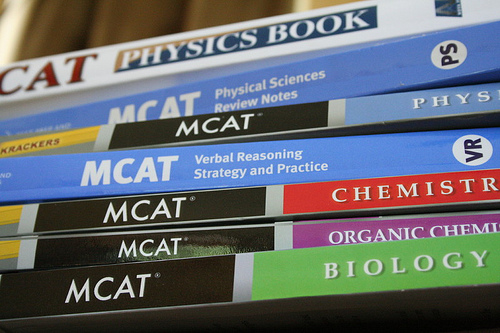
Content wise, the prep books and materials that are developed by Kaplan focus on the fundamentals, most of which are crucial for easier comprehension and understanding of the more advanced concepts. There are a total of six prep books that are provided to enrollees which directly correspond to the basic subjects tackled in the MCAT.
- General chemistry
- Organic chemistry
- Biology
- Physics
- Verbal reasoning
- Writing
These prep books are a result of the hard work and years of expertise by Kaplan instructors. A compilation of previous MCAT questionnaires and materials from the AAMC can be found on all prep books and are delivered in a manner that can be easily understood and grasped by premed students.
Another great advantage of opting to take Kaplan MCAT prep course is that they offer the greatest number of test materials, thus ensuring improvement in the test taking skills of premed students and delivering confidence- a quality which all premed students obviously need to endure the grueling MCAT.
The instructors from Kaplan are the best teachers in the industry. They utilize innovative and cutting-edge tools to communicate concepts more easily and effectively as well as to ensure optimum comprehension among its students. The online access to test materials such as those provided by AAMC gives enrollees the opportunity to practice their skills and knowledge at their own preferred time and place.
Kaplan MCAT enrollees are assessed periodically and progress charts are initiated so premed students can immediately check how they are doing so far during the preparation months. Kaplan’s Smart Report page ensures that students can readily check their rate of progress and improvement so they are accordingly guided in which areas are their weaknesses and which are their key strengths too.
Although the Kaplan MCAT prep courses are relatively more expensive with a price range of $1899 up to $7,749 per course, their High Score Guarantee gives test-takers the peace of mind as well as confidence that competing MCAT prep course centers can only hope to offer.
The Kaplan MCAT prep course is an important tool that you will need to pass this all-important examination. However, it is only a part of the equation. Discipline as well as determination on the end of a student is a requirement to become successful in taking the MCAT, and eventually become an accomplished medical doctor in the future.
 Loading ...